

Rewriting What is Given
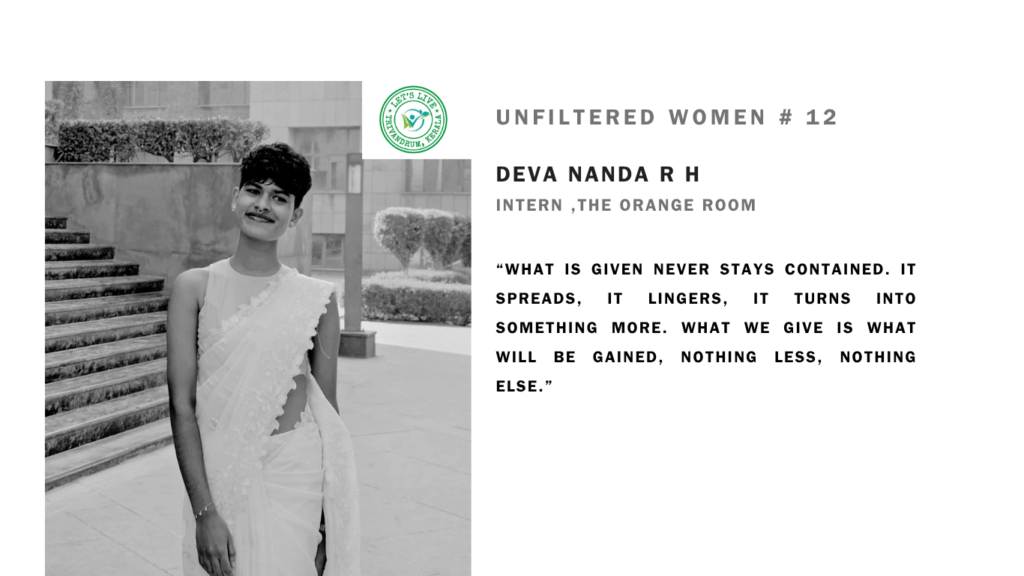
What is given never stays contained. It spreads, it lingers, it turns into something more. What we give is what will be gained, nothing less, nothing else.
I was born and brought up in a village on the outskirts of Trivandrum. Here, patriarchy doesn’t always shout; it sits quietly in every home, sometimes obvious, sometimes subtle, but always present. In many homes I know, there was a pair of siblings, a boy and a girl, and more often than not, the sister was the elder. But birth order didn’t matter. The brother still stood a step higher in the hierarchy, except in mine.
The boys seemed to grow up with an unspoken authority over what they would do, what they could wear, where they could go. It was never announced, never questioned, just… given. Even though it didn’t dictate my life directly, it stayed around me, and it pissed me off more than I like to admit. Because somewhere along the way, I realised this wasn’t just about roles or rules, it was about freedom, and who gets more of it.
Everyone is layered with thoughts of patriarchy. The privileges men are given feel default, and the adjustments and suppression expected from women are normalised. Many who live within it are so used to it that they don’t even realise there is a life beyond it. Even those who don’t want to carry it forward often end up doing so, unknowingly, because of how consistently it is present and practiced from the very beginning.
I’ve also seen how this gets reinforced. When my brother would wash my clothes when I was sick, or help clean the house, it wasn’t seen as normal. It was mocked. Joked about. Questioned. And that’s how it begins again, how children are pushed back into roles they didn’t choose.
This is how they are raised. Not just at home, but everywhere around them. In passing comments, in laughter, in what is approved and what is ridiculed. And slowly, they learn what is expected of them, and what is not.
If a boy is raised teaching him to leave his plate after a meal for some woman at home to clean, he will carry that forward, no matter how old he gets. Leaving a plate might sound small, but it rarely stays that way. It grows into something heavier. Because nothing begins big, everything begins with what we choose to normalise.
Once, while walking to my music class with my brother, on our way, a random person asked him, “Where are you both heading?” He answered, “I’m taking my sister to music class.” He was just 9 years old then. That sentence didn’t sit right with me. It carried a weight I didn’t ask for, as if he was there to look after me, as if I needed it. I stopped him and said, “You’re not coming to take care of me, we are just going together.”
Later, I kept thinking about why he said it that way. Finding the answer wasn’t that simple, because we were raised by two humans who never confined themselves to gender roles, and our home was so fluid that no work was assigned as just my mom’s or my dad’s. And the answer, when it came, was clear, it was never really his sentence to begin with. It was something he had heard, over and over again, from the people around us. Even after being nurtured in such an environment, from a random mouth, he had learned that I needed protection simply because I am a girl.
And that’s where “give to gain” begins to make sense. What is given, even unknowingly, doesn’t disappear, it settles, it repeats, it becomes. But maybe it can be questioned. Maybe it can be unlearned and relearned.
Since then, we’ve had our own conversations, not because he was ready for such heavy ones, but because in a world filled with patriarchy and privileges I never agreed with, I didn’t want to plant those into his mind. As we are shown, so we become. So I chose to show him that he and I are not roles handed down, neither “man” nor “woman” as hierarchy, but individuals. That neither of us is above or below the other. That gender doesn’t come with authority, it only comes with assumptions. And some of those, we’ve decided not to carry forward.
Raising him made me realise that what we give is what gets gained later. Unlike many we grew up around, we learned to coexist, not as roles placed above or below each other, but as individuals who support without controlling and care without dominating. Raising him made me realise that intention in upbringing shapes the kind of human that grows.
We did not let hierarchy take root. We did not let gender decide worth.
What is given never stays contained. It spreads, it lingers, it turns into something more. What we give is what will be gained, nothing less, nothing else.
Deva Nanda R H ( Psychology Intern, The Orange Room)