

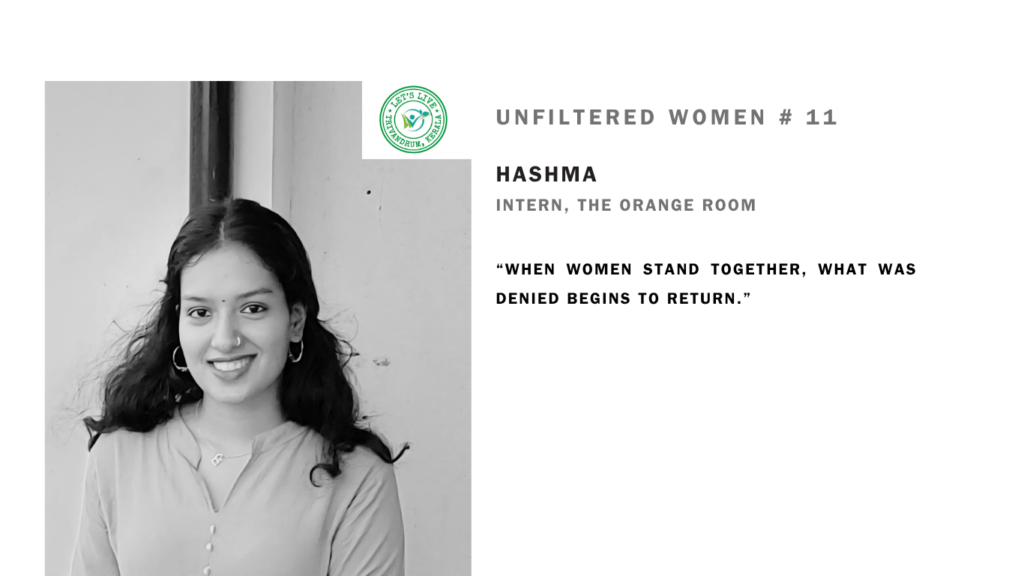
Not Given, But Denied
When women stand together, what was denied begins to return.
I have often found myself questioning widely accepted ideas without pause. One such idea is this: why must women “gain” what has always been their birthright? Why is empowerment framed as something to be given, rather than something that was unjustly withheld?
I strongly believe in intersectional feminism, the understanding that womanhood is not one uniform experience. Our realities are shaped by caste, class, culture, and identity. Yet across these differences, there is a shared truth: navigating a world structured by patriarchy and sustained, often quietly, by misogyny.
There is no single defining moment in my life that stands apart as the struggle. Every moment, in its own way, has been one. Each time I chose to speak instead of remain silent. Each time I questioned what was normalized. Each time I resisted the subtle expectations to shrink, adjust, or accommodate. These moments may not appear extraordinary, but together, they form a continuous act of resistance.
The theme “Give to Gain” makes me pause. It suggests that something must be given in order to receive. But I wonder, why must women continue to give, to prove, to negotiate, just to access what should have always been theirs? Perhaps the meaning lies elsewhere. Perhaps what we must give is not proof of our worth, but solidarity.
Because when women stand with one another across differences, without judgment, without competition, we begin to dismantle the very structures that made this “giving” necessary. In that collective strength, we do not gain something new; we reclaim what was always ours.
As Arundhati Roy reminds us, “Another world is not only possible, she is on her way. On a quiet day, I can hear her breathing.” Perhaps that world begins in these moments of solidarity.
When women stand together, what was denied begins to return.
Hashma (Psychology Intern, The Orange Room)