

“Sometimes, you don’t grow wrong. You just grow in the wrong room.”
For most of my school years, I lived with a quiet ache, the feeling of being slightly misplaced. I had friends, routines, and marks on report cards, yet something inside me stayed untouched, unseen. I often felt like a visitor in a space that wasn’t meant for me. The classrooms felt heavy, the subjects distant, and I carried the silent belief that I was average, ordinary, and not someone who fully fit anywhere. But life has gentle ways of waiting for the right moment.
COVID paused the world, and when it resumed, my life led me toward the decision my seventh-grade self once made without understanding: Psychology.
And suddenly, the world shifted its shape around me.
“And then the day came when the risk to remain tight in a bud was more painful than the risk to bloom.”
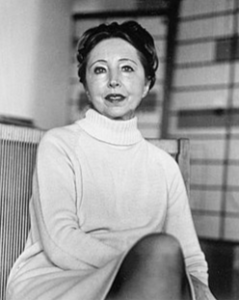
Image credit: © The Anaïs Nin Foundation. All Rights Reserved.
— Anaïs Nin
Stepping into psychology felt like stepping into light. College didn’t just teach me theories; it taught me myself. For the first time, I was in a space where my softness wasn’t a misunderstanding, where my curiosity wasn’t strange, and where my quietness didn’t need to apologise. I became someone who was seen. Someone who was appreciated.Someone who finally belonged. It felt as if a part of me that had been sleeping for years finally opened its eyes and recognised itself.
“When a flower doesn’t bloom, you fix the environment, not the flower.”
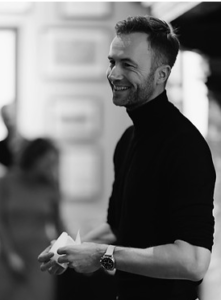
Image credit: © Alexander den Heijer. All Rights Reserved.
— Alexander Den Heijer
Psychology gave me language for emotions I had carried since childhood. It showed me that belonging is not about fitting everywhere. It’s about finding the one place where your inner world finally meets the outer one.
And today, being part of Let’s Live, I carry that truth with me. I want to help create the kind of spaces that once saved me — soft, safe, understanding spaces where someone who feels invisible can finally exhale and be seen.
“You will bloom in the place that feels like sunlight to you.”
If you feel out of place right now, I hope my story reminds you gently:
You are not hard to love, you are not difficult to understand, and you are not meant to shrink yourself to fit into the wrong spaces.
Your place exists.
And when you find it, you will bloom without even trying.
Death and darkness are normal for me. What can shake an average person comforts me, likely due to the varied experiences I have had ever since I was born. At 1 1/2years of age I was considered medically dead while kept alive by machines for a month. As a kid until today I continue being a mischief and misfit in everything I do and everywhere I go.
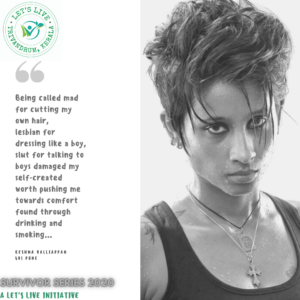
Self-harming began early in my life before age 6. This isn’t considered normal yet it is a normal reaction to an irrational childhood of being locked in toilets for hours, being left under the care of maids, uncles and horror porn movies that kept me glued with curiosity and not fear. As an adolescent popularity in school kept me alive though yet lonely. Being called mad for cutting my own hair, lesbian for dressing like a boy, slut for talking to boys damaged my self-created worth pushing me towards comfort found through drinking and smoking. I was treated for my deviancy, and vandalism after I ran away from home, cycling 156kms to another state where I discovered a world where men liked boys and I looked like one. Freedom came with a price which forced me to return home 36 hours later yet I was not happy about it and wished I would never return. Everyone was angry with me for having run away, for making them worried, yet no one genuinely inquired about what happened when I was away, so I continued living my own lie having given up on adults. A psychiatrist diagnosed me as a transvestite and suggested sex change to my parents. This complicated things between us, having them decide on drastic measures by sending me to various fixing camps aka tough love camps. I realized my own horror movie had just begun as these camps are meant to break your spirit, tear you apart emotionally, mentally, physically, sexually and spiritually through tactical military style behavioral strategies. I returned home each time a different person hating myself and my parents further, although my obedient nature was now loved by all as I did as I was told, dressed as I was given, listened and followed every rule of how to conduct myself as a girl.
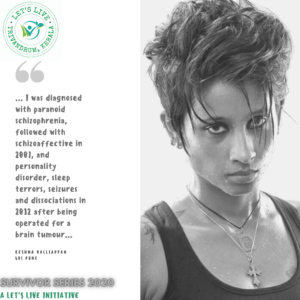
I was moved to India in 96, under the pretext of a 2 month holiday which turned into 6 years. During these years, there was a lot of back and forth that interrupted my studies. Each time when I was beginning to settle with a new set of friends, gaining confidence in my studies I was forced to leave my studies owing to some mood swing a parent had. My insomnia that began at age 14 only increased. I thought and felt I was an imbecile as I could not keep up with the pressures of constant change and learning in a different language, culture and society. Back then Indians thought Bermuda shorts were underwear and so I was repeatedly teased by other adults, forcing me to dress in salwar kameez and turn into a good Indian girl. By 2001, I lived on the streets sleeping under benches or abandoned rooms in college while my diet consisted of alcohol, cigarettes and drugs when I could afford them or sell a part of myself for it. I would return home to shower or eat and leave under the excuse of staying at a friend’s. Arguments and fights led to my breakdown among many other things. By the end of 2002, I was diagnosed with paranoid schizophrenia, followed with schizoaffective in 2007, and personality disorder, sleep terrors, seizures and dissociations in 2012 after being operated for a brain tumour.
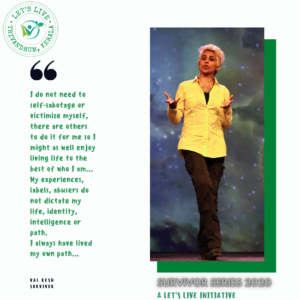
I have killed myself many times throughout it all – each time asking myself ‘I got the concoctions right, why did I survive?’ A young friend – the only real one I had throughout my schizophrenia treatment told me ‘Didi, have you not got it? You want to live so much that you will not die. Your spirit won’t allow you too. You told me this yourself.’ Her words have never left me. I have come to acknowledge and accept that irrespective of how disturbing or damaging my hurdles in life were, of authority trying to break my spirit, my affair with death was not about killing myself but to kill that thought, or person I held responsible although I couldn’t make them accountable. Why was I hurting myself when there was enough done to me? As I teach my teenage students in school I have come to grow with them as a human, to know that being kind and compassionate to myself is what matters. I do not need to self-sabotage or victimize myself, there are others to do it for me so I might as well enjoy living life to the best of who I am and not how others have made up of me.
My experiences, labels, abusers do not dictate my life, identity, intelligence or path. I always have lived my own path, it is for that reason they wanted to fix me each time. We easily give our power to others even in the minute we blame them for what they did to us. This sense of agency is not theirs but mine alone. What I do with it is my power and as long as I don’t play the victim card even with society and the stigma being evident through the varied diagnosis, no one has the power to use it against me. We are all capable of adapting, camouflaging and moving further, it is why we have survived what we have. The next step is to live and love ourselves. The rest just follows through effortlessly.
— Val Resh–
Hey I am Jyothisha and here’s my journey of survival.
I was diagnosed with Borderline Personality Disorder (BPD) in the later half of my twenties and I was thrilled at the diagnosis. After years of living with a super puzzling self-identity and shifting self-image, I could finally understand why I did what I did. Now I knew why I made irrational impulsive decisions, had destructive, consuming rage, sabotaged relationships and more…
I realized I had a mood disorder and was not a ‘bad’ or ‘immature’ person. I stopped hating and blaming myself. I convinced myself I deserved kindness. Understanding BPD helped me make sense of my own mind and feelings, or the lack of it. It helped me rationalize my actions, past and present.
Most importantly, I could now understand why and how I always dealt with pain and found it more difficult than others to return to the ’emotional baseline’, simply meaning just getting back to ‘being ok’.
In the past one year or so, working my way through therapy and self-awareness exercises, I have gained some control over my frequent mood swings. With awareness, my decisions are more thought out and considered, and my life is getting calmer. The process wasn’t easy. It meant leaving people, places and self-destructive habits. It meant learning to communicate more effectively and not masking agony in rage.
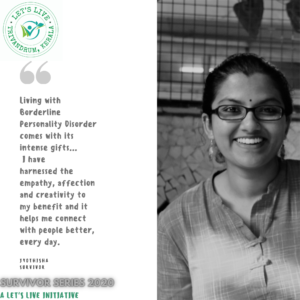
It meant being bold about my vulnerabilities, accepting them and working to better them. As I grow more and more aware and comfortable with my ‘BPDness’, I do feel more and more peaceful both internally and externally. Living with BPD comes with its intense gifts. I have harnessed the empathy, affection and creativity to my benefit and it helps me connect with people better, every day.
I also found my purpose in bettering my career and becoming a better version of myself- each day. I am finally committed to taking care of myself and there are more good days than ever.
–Jyothisha–
Hey I am Vani. And here’s my story of survival.
There have been many instances in my life where I’ve felt that “this was worth living for”. But many more where I wished I could die. My journey has been incredible. I never thought I’d be someone who would want to end my life until one day I just did
Looking back, it was just the feeling of hopelessness. Thinking that the world had nothing to offer. That’s when the thoughts creeped-in. Maybe the feeling that no one would miss me if I was gone?
My life wasn’t always the best life. I was bullied in school and misunderstood at home. I did get good grades but no one could understand me. And that left a void inside of me that I couldn’t ever fill. But as I grew up the problem got worse. The financial crisis my family faced was the worst blow. We had years where there was no income in the house and we barely scraped together enough to survive.
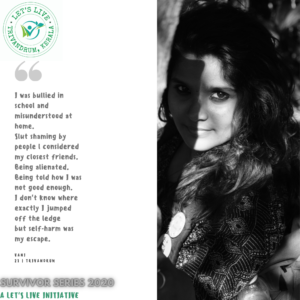
Then layers of what happens to women happened to me too. Slut shaming by people l considered my closest friends. Being alienated. Being told how I was not good enough. How I was a burden in more than one way. Being related to an alcoholic. Undergoing trauma mentally and physically. I don’t know where exactly I jumped off the ledge but self-harm was my escape.
I went through everything life could throw at me except maybe deadly diseases. I thought it was better for me to be dead than alive. For everyone including me. But it was long before I realised I was wrong. I’m Vani and I’m a survivor. It’s still hard sometimes to live but the love and care people have shown me and how the world opened its arms for me when I welcomed it… made me realise maybe it’s not so bad to live longer… Happier.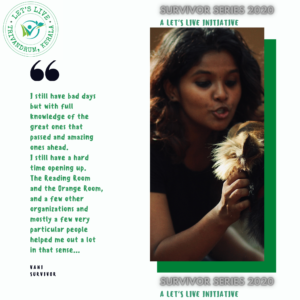
I still have bad days but with full knowledge of the great ones that passed and amazing ones ahead. I still have a hard time opening up. The Reading Room and the Orange Room, and a few other organizations and mostly a few very particular people helped me out a lot in that sense. Some have done more damage after they’ve helped me too. The cycle is weird. But along the way somehow I learnt to help myself. And now, I’m more alive than I’ve ever been. It all just takes time. Maybe it’s okay to live, one day at a time.
— Vani
I am Sangeetha Param. I am from Bangalore, India. And here’s my story of survival.
When a person stands in front of a mirror, it reflects their image. A meaning is giving to the image by the person through feelings, emotions and thoughts. Waking up one day, I stood in front of the mirror and gave meaning to the image I saw. I saw a girl in pain. She had scars, both visible and invisible. The fat accumulated around her skin filled with unresolved issues and baggage. Her eyes filled with tears and as she blinked they fell on her cheeks. I stood there watching my body become numb as sadness attacked me like a swarm of bees. Depression had set in. The wounds which I had hid from the sunlight for years opened up and they burnt as the moisture in the air touched them.
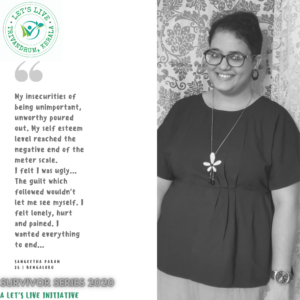 My insecurities of being unimportant, unworthy poured out. My self esteem level reached the negative end of the meter scale. I felt I was ugly. I looked down at my feet as I remembered the mistakes I made. The guilt which followed wouldn’t let me see myself. I felt lonely, hurt and pained. I wanted everything to end. In November 2014, I walked out of my house hoping to come back lifeless. Fortunately or unfortunately, life had different plans for me. My family saw me fall into the pit of depression and did everything they could to bring me out of the pit. I was taken to different therapists and psychiatrists. I was put on medication and given intense therapy as I was diagnosed with Bipolar Disorder ( also known as Manic Depression where a person experiences extreme mood swings of mania and depression) and Borderline Personality Disorder (which is a mental health disorder that affects one’s way of thinking and feeling about oneself which includes self-image issues, difficulty in managing emotions and behavior and a pattern of unstable relationships).
I breathed a sigh of relief being tagged with these terms as now there was a scientific reason to what was happening and everything was not something I created in my head intentionally. I was told that there were many people in the world who were diagnosed with the same. My Bipolar Disorder was managed with medication and my Borderline Personality Disorder was managed with therapy. I had my roller-coaster rides even after medication and therapy. I thought I would be fixed but only then I understood that this is a lifetime challenge I will have to face.
I have been bullied, sexually assaulted and what not. When I was 11 years old, we had an uninvited guest. It was death who came knocking threatening to take my father’s life by giving him Blood Cancer. We fought against death as a family and won the battle. The reality of life was brought to my eyes at a very young age. I stepped into the shoes of an adult even before I became a teenager. As a teenager, I had a lot of problems dealing with my unstable mind leading me to become impulsive. I self harmed a lot and ended up becoming addicted to it. I developed abandonment issues as I lost a lot of friends. My self confidence dropped to the bottom and eventually I reached the last year of my teens. I thought my problems would end with the end of my teens years, but guess that was a wish too soon. It was just the beginning.
 In 2015, the Cancer organization my father belongs to called for an essay writing competition. It was during the time I was in the trough end of the wave filled with depression and negativity. My father insisted I give it a shot and I read the topic. It read, “A caregiver’s experience with a cancer patient”. I sat and wrote. I typed and typed and I didn’t stop. By the time I was done, I had 2 pages filled with words and two eyes filled with tears. My father read my essay, made a few changes and we clicked submit. In a few days we got a call that my essay won the competition. Overjoyed, I opened the word document to see it was a huge space for me to pour my feelings. A judgment free world, I began to write. I wrote down every feeling, emotion and thought and I gave me solace. Little did I know at the age of 20 I will discover my love for writing which was therapeutic for me.
The year 2018 gave a gift of confidence. Watching my father give talks on his cancer survival story, I was inspired to do the same on mental health. The hope in the listener’s eyes, “If he can beat cancer, I can too” got me thinking in the lines that, “I waited 20 years to speak about my pain, there might be so many out there who are afraid to speak about their mental health.” I gave my first talk in a cafe and since then I have been trying for opportunities where I can speak my story so that in a crowd at least even if 1 person takes home a lesson my intentions were met. I gave two Ted talks following that out of which in one I shared the stage with my father.
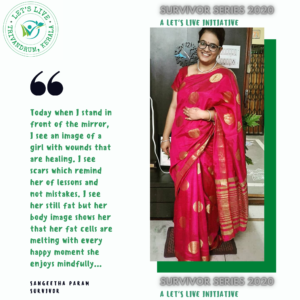
When I speak my story, I feel and relive every emotion which teaches me one thing, “An incident can cause you pain which might kill you, but as days go by if you feel 0.00001 less pain out of 100, you got to pat yourself in the back for making an effort to get better.” Today when I stand in front of the mirror, I see an image of a girl with wounds that are healing. I see scars which remind her of lessons and not mistakes. I see her still fat but her body image shows her that her fat cells are melting with every happy moment she enjoys mindfully. I will always have my memories and my pain, it will always be a part of me. Today I won’t be who I am if not for them. Make your painful memories into fairy tales with lessons like you are reading from a child’s book. A mirror reflects an image, it is you who gives meaning to it. The image, you, remain constant but it is how you reflect upon the reflection is what matters.
— Sangeetha Param —
Hi I’m Radhika and here is my story of survival.
It was a regular winter morning. The winters in Chennai are surprisingly cold and misty just like my mood at the time. At around 5 in the morning I scrambled out of my tiny hostel bed with heavy insomnia affected eyes and ran to the terrace to call my dad and cry. I was 19 and this was my ‘fresh’ life. Weirdly enough even after 6 months of moving to Chennai for my degree nothing felt fresh except the morning air!
 I was the child that most families would label ‘troubled’ or ‘not raised properly’. On the contrary I was a perfectly raised child with the perfect parents and the only problem I had was being exposed to different cultures. Raised abroad I was used to the freedom that I had. Nobody to question my choices of expressing myself and there was nothing my parents thought was wrong with me. I was a free bird who was promised loving grandparents, a whole family of cousins, uncles, aunts and everything, but nothing felt right. As soon as I landed in Kerala to settle down nothing was to compromise for a 10 year old’s choices. Crossed legs? How rude! Short skirt? Cultureless. A shake hand? You can’t touch boys! I couldn’t understand what I was doing wrong but somehow everything I did was wrong! Now this might be silly in a grown man’s world but for a child who just left her best friends, her school, her favourite teachers and her loving home this was unwelcoming and huge! My adjustment problems and depression started there.
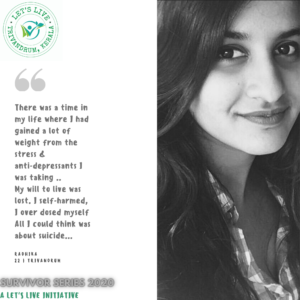
I started becoming a rebel. Aggression was my tool for defending myself. At the age of 11 a very known family friend mistreated me and everyone was convinced that he was only showing his affection towards a child! At 22 years now I still know that my body was violated. The aggressive behaviour increased and my parents couldn’t handle the pressure by then as they had a new born child to look after too. So I became the ultimate loose thread in the family. I made a lot of friends in my high school. Both girls and boys. With all my frustrations, I trusted each one of them blindly until most of them stripped me of my money and used me for my physical appearance. I was slut shamed and humiliated for my difference in opinion and for the fact that I was raised abroad. I changed 4 schools and the last one, a very famous all girls convent school in Trivandrum called me a druggie and attention seeker for riding back home on a bike with my cousin brother! Apparently that was my boyfriend but since my parents denied the school’s accusations and asked them to leave me alone they labeled me a druggie! There was a time in my life where I had gained a lot of weight from the stress and anti-depressants I was taking but this had people ridicule me and calling me pregnant publicly! My will to live was lost. I self-harmed, I over dosed myself all I could think was suicide.
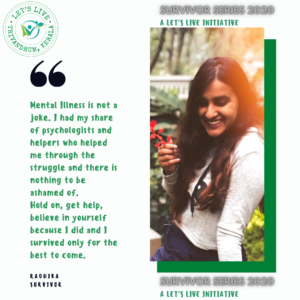 For my college I finally managed to escape my terrible life and start fresh in Chennai, but the past kept haunting me. I was restless , sleepless and on the verge of giving up everything. I had made up my mind on that one early morning when my dad told me over the phone “Radhu the whole world might have given up on you, but I have never stopped believing in you and I never will. If you could survive through all these demons in person then your thoughts are just their shadows which will soon fade away. You’re stronger than you think you are so don’t give up on yourself when we are here to hold you up” at that moment I knew exactly what I had to do. A pang of guilt rippled through my body and I kept apologising for all the mistakes that I have done brainlessly. My father never questioned me, my mother never stopped holding my hand as we took our long morning walks, my sister never stopped calling me her hero and my fiancé never stopped loving despite the whole unthinkable past. Yes 3 years since that cold winter morning I am a Social work graduate from a prestigious college with amazing scores. I have the best, most trustworthy loving friends anyone could ask for. I fell in love and got engaged to the man who held my hand and helped me fight through the darkness while I was in Chennai, I sleep 8 hours a day or even more and I’m a huge adventure scout! My parents are my strength and I am definitely not the ‘trouble maker’. Everything is fresh, clear and pure.
Mental Illness is not a joke. I had my share of psychologists and helpers who helped me through the struggle and there is nothing to be ashamed of. I fought my way through and trust me at the end of the tunnel there is always hope and if you are going through a tough time it’s just too far to see right now and you have to hold on a little more to see it, but it’s definitely there. Hold on, get help, believe in yourself because I did and I survived only for the best to come.
— Radhika
My name is Zenia and I am a Mental Health Practitioner currently based out of Delhi. And here’s my story of survival.
 My father had a transferable job and I grew up in different places across India. The kind of grounding that staying in one place provides was missing. I would experience nervousness, hesitation and confusion in the first few months of moving to a new place and it would be time to move to a new place just when I felt settled and comfortable. The fact that I was shy and lacked confidence, made matters worse. Overtly negative, dreadful, imagined thoughts, about losing loved ones, failing tests, getting lost, hurt or killed clouded my head. As much as I wanted these thoughts to end, they wouldn’t and I would be lost in them. Adults around me described the younger me as someone lost in her own world. It’s difficult to say what led to what; the constant moving places led to anxiety or was it the existing anxiety that made moving places difficult. With time, I did make peace with the process of moving from one place to another and accepted it as a part of my life.
It’s difficult to think of a period of life when I wasn’t anxious but my anxiety took a turn for the worse when I was 15 years old. The anxiety was starting to take over my body now. I started experiencing dizziness; a lack of balance and steadiness. People around me were clueless about what was happening to me and this led to my first bout of hypochondria, “I have some serious disease and I will die.” This is what played in my head constantly. It was around this time that my father got posted to Brazil and I too shifted there. Brazil was a world so different from anything that I had ever seen before. The culture, the language, the school system, the food, the weather, everything seemed alien. My school was a high end American school catering to American and Brazilian kids from the upper class. This was a quantum leap for somebody who studied all her life in the state-run Kendriya Vidyalaya in India. The smaller community of international students was where I felt at home, at times. The small yet significant experiences of exclusion and prejudice as a brown girl coupled with my lack of self esteem and tendency to worry excessively made my situation worse and I had a breakdown.
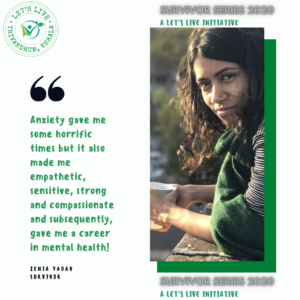 Things could have really gone out of hand for me if it was not my parents. They were not dismissive of what I felt and helped me in seeking external support. I was introduced to therapy and it was there that I first learnt the term Anxiety Disorder. This approach of my parents was crucial and I want to stress on this. Many times, we are dismissive and equate other people’s experiences and journeys with our own. They thankfully didn’t. They didn’t depend on their past experiences. They read up on Anxiety Disorder, tried to inform themselves and provided the kind of support that is required. The lack of awareness was something that increased my anxiety. But with an increasing awareness and informed avenues to talk about anxiety, I was able to control the seemingly never-ending negative ruminations. I recognized my positive qualities and values and realized that those were my strengths. Things are not perfect even today and, probably, they never will be. But I am in this pursuit of understanding what goes within, what little changes can be done, how much we do not know and there is so much to learn. I try to embrace myself as a whole; the flawed person that I am. Somedays I succeed, somedays I do not. On the days that I do not, I take solace in the fact that it’s okay to not feel okay. I reach out for help. I read. I exercise. I breathe. I listen to other survivors for hope and inspiration. There’s some really good and helpful stuff out there. Anxiety gave me some horrific times but it also made me empathetic, sensitive, strong and compassionate and subsequently, gave me a career in mental health.
— Zenia Yadav
Being an only child to my parents brings a whole hearted love to me…ours was a happy little family…until my mom passed away when I was 10!
After that my dad bought me up very well until my education days, during my final semester in college an issue made my dad to hate me as I was against him in selling a property which was built by my mom. He overlooked my opinion as a family member. While my friends supported my decision, my own dad did not – he disregarded my opinion about my mother’s property. Finally when he won it, along with I was dropped to the streets .He wanted me to survive all by myself. I tried to get help from my relatives but they didn’t listen to me and abandoned me. I was left with 2 pairs of clothes and a course completion certificate with 2 back papers in my last semester. I got anxious and depressed. Loneliness had hit me hard; I lost around 15 Kilograms of weight. I felt that my life was over!
Finally I got help from my family friends and my own friends. With their help I cleared the exams and joined a specialization course in my field of study! And finally I got a trainee job in MSME. Later I went back to meet my dad. He was still angry with me for a few years. Till date my dad and I , we live our lives at separate places in the same city.
Now I understand him better. Indirectly he has taught me to survive alone – at the end of the day you only have yourself. My Hobbies and my passion for music and movies made me motivated as I slowly understood life… as it’s a journey we are learning, experiencing, discovering and balancing it!
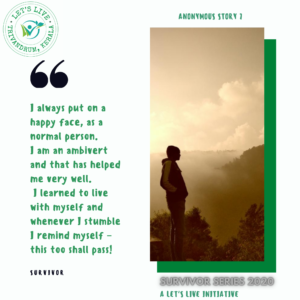
I always put on a happy face, as a normal person. I am an ambivert and that has helped me very well. I learned to live with myself and whenever I stumble I remind myself – this too shall pass!
I was raised to be an independent woman, a perfectionist. I completed a professional course, worked for sometime and then got involved in a business enterprise started by my family. My parents were not very expressive and I never had a close relationship with my parents or siblings during my childhood. Then, like a dream come true, I met the love of my life through an arranged meeting set up by my parents. He was an intelligent guy, well placed in life, selfless, humourous, and a very affectionate person. This earned him a lot of friends too and he loved all of them. My life seemed perfect with a doting husband and two adorable children.
My husband used to spend long hours outside the house with friends and we used to have family get together too very often. Over the years he got addicted to alcohol and this led to constant fights between us triggered by his abnormal behaviour after drinking. I felt helpless in the beginning and very embarrassed, and couldn’t come to terms with what was happening in my seemingly perfect life. Tried to convince him about his drinking habits many times but he was always in denial and that frustrated me a lot. I used to think about divorce, suicide, running away from home. Since I never spoke to anyone about my problems at home all this was always kept a secret no matter how hard it was. I wanted some diversion and hence I signed up for a 2 year part time course that gave me no time to worry. Then whenever there was an issue at home, I started writing to my husband about the feelings in my mind, it didn’t matter whether he read it or not. I felt relieved after writing to him. I started reading about alcoholism, about treatment and strategies to cope and I realised that many people had faced similar issues in the past and yes… there was a solution.
 I started speaking to a few close friends about the issues at home and then I never felt alone. I reached out to a few mental health professionals for help. And , one day, I met Sherin, the founder of Let’s Live and attended the sessions organised by her. I heard similar stories from a few people who attended the sessions there and realised I was not alone. A strong support system like The Orange Room, helped me cope with my issue in a much better way. I felt positive and happy once again. This new found energy helped me convince my husband and get him to start treatment for alcoholism and the fight is on. It will take many years probably but I am hopeful and positive that he will gain total control one day.
From my experience I feel that alcoholism can be treated though it is very challenging and it requires a lot of patience. People suffering from alcoholism need to be identified and treated not isolated. There could be underlying mental health issues which must have led them to alcoholism. They need help. Seek professional help for them. Share your problems with anyone you trust. Friends and social support groups give us more strength to cope and remain positive about life.
I have a loving husband, a wonderful child, a good job, a supportive family and all I wanted was to end my life. I knew something was wrong but didn’t know what it was. I had carried so much over decades – an absent father, broken relationships, family issues, work-related stress. All those pent-up emotions started coming out in varied forms – as anger, anxiety, an absolute blankness, an inexplicable sadness. I couldn’t make sense of anything, it was so overwhelming. The mind went numb, and frequently.
It was sheer coincidence that I received a mail about an employee assistance program in my office. It was an initiative aimed at ensuring the mental wellbeing of the company workforce. I spoke to a therapist and that’s how my journey to recovery started.
I’ve been in therapy for over two years now and I’m glad that I took the first step. It has helped me understand my feelings, emotions and thought processes better; it has helped me introspect deeply. It’s like facing a mirror and it reflects all your good angles and rough edges which you didn’t know existed. It answers the Why on a lot of things, whether you are ready to accept them or not. Therapy is not a smooth ride; the more we started dredging, I started getting regular nightmares. As I adopted methods suggested by my therapist, the frequency of these nightmares came down and eventually stopped.
I, however, was sure about one thing – it helped me deal with my issues, it helped me decide against dodging them or pretending to ignore them. It gave me the courage to speak with my molester. I didn’t even realize that the incident which happened 35 year back had bothered me so much till I went to therapy. I was so clear on what I had to tell the person and when the conversation was over, I felt light. What I did felt so right. I was so glad that I spoke. For the first time, I understood what ‘dealing with something’ really meant. That is when I realized that I am on course to recovery.
After two years of therapy, I can say that I am in a much better space now. It’s very important that you find the right therapist – someone you can connect with, someone you can trust, someone who holds the boundaries as sacred, gives the freedom to discuss or not discuss something and changes the direction of therapy if the approach doesn’t work. It’s a given that the person should be empathetic, caring and not imposing his or her thoughts on “the right and the wrong” on you. A good therapist doesn’t decide things for you. He/she guides you to take your own decisions. I’m glad I found the right person and I am indebted to him forever.
I feel it’s very important to understand the diverse aspects of mental health. It’s important to read more about it since there are a lot of myths surrounding the subject. While dealing with the condition, I also had to work around uninformed, damaging responses and advices from well-meaning people. These myths are to be broken down.
- If you are a mother and you have a cheerful little one at home, you can never get depressed
- I also felt depressed last week when I missed the train
- Life is full of ups and downs; we should be strong enough to face all that, don’t be weak
- Everyone has problems, don’t make a big deal of yours
- Forgive people and you live in peace
- Forget the past and live in the present otherwise you will be unhappy forever
- Therapy is like addiction, you can never come out of it
- Meditation is better than therapy and it’s free
I am working towards creating awareness about mental wellbeing. I am also trying to break myths around the subject – one at-a-time.
Hi, I am Geetanjali, a graduate student and researcher, currently based in the US. And here’s my story of survival.
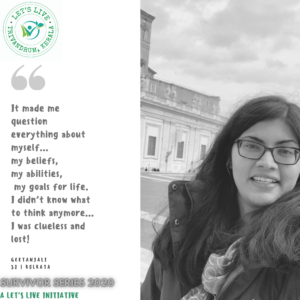
Growing up, I always knew I was more sensitive than most people around me. And I believed it to be a good thing, to have the ability to feel deeply, to be compassionate. However, having lived a rather sheltered life, I didn’t have that much to feel sad about. I was as happy, ambitious, even confident, as any other person. Of course, not everything was rosy, I shed my share of tears, had my fears, but always, I had also had hope. Back then, any time I faced a setback, I would get disheartened but I never thought of myself as depressed. Until, that is, depression hit me flat in the face and knocked me down so bad, I thought I would never get up again. It was triggered by a heartbreak, just as I started my PhD.
Dealing with depression is the hardest thing I have ever done. It made me question everything about myself: my beliefs, my abilities, my goals for life. It was as if everything I had had suddenly disappeared, leaving me hanging with nothing to hold on to. I didn’t know what to think anymore; I was clueless and lost. I figured I must be doing something wrong, and that’s why my life seems to be falling apart with no hope to turn things around. Over and over in my head, I would try to figure out why I didn’t deserve anything. I could see myself losing control of my life; I felt confused and angry and hurt. Of course, as a direct consequence, my academics also greatly suffered, and that made my life even more difficult.
I was in so much pain, I was desperate to find any means to get out of it. I decided to try every possible thing I could think of, to help myself feel a little bit better. I went into therapy, started taking medication, reached out to my closest friends, tried to learn to meditate, filled endless pages with incoherent, rambling thoughts in the hope of untangling the turmoil in my head. For a long while, nothing seemed to be working. I began to find comfort in the idea of suicide. I thought if I just killed myself, I wouldn’t feel the pain anymore. Everyday things made my life hard. Every memory from the life I had had in the past, happy or sad, was disturbing to me. All music was jarring to my ears, sleeping was scary because I was haunted by nightmares, I was weak and always exhausted but struggled to eat. Getting through each day felt like carrying a big boulder on my back in pursuit of some unreachable destination.
My understanding is that there really isn’t any shortcut out of depression. Everyone has to go through the agony, capitalize on resources they can find, and try to build their strength, both physical and mental, until it becomes more manageable. That is why it is so important to show kindness to everyone, because we don’t know what they are going through, but feeling supported will definitely help them get through whatever it is. I was away from family, and only had a dwindling connection with them. But I had some great friends, who carried me forward when I couldn’t walk on my own anymore and never left my side. The combined effect of all the resources I had at my aid helped me hold on, however miserable I felt.
 I think what I sought most during my lowest lows was not necessarily a solution to my immediate problems, but some comfort and hope to find the strength to be up on my feet again. Once the fog began to thin out, I took to heart some words that my therapist once said to me: “the opposite of depression is action”. When I was able to build up some physical and mental strength, I tried to make myself a problem-solver. I decided that for every problem, I must find solutions in some sort of “action”, one problem at a time. I couldn’t stop and think, because being a pessimist, I was incapable of thinking anything not depressing. Besides having my friends, other little things that brought me some comfort were: listening to the Harry Potter audiobooks to sleep every night (the Stephen Fry version, not the American one), making/eating desserts, solo travel, reading about history, cuddling a chubby stuffed bunny, looking at cute gifs, watching sitcoms, venting out to friends, trying to rebuild my relationship with my family.
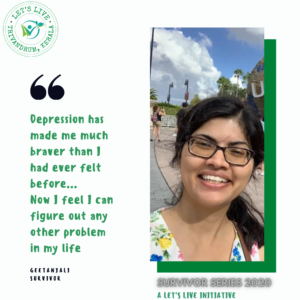
Depression has made me much braver than I had ever felt before. Dealing with my low spells was such a herculean task to me, that I feel any other problem I can figure out. I feel very small and frail when I feel low, but every time my thoughts turn back to how bad I had felt in the past, I start to believe that I must be tough to have lived through that nightmare. It makes me feel a little proud of myself.
— Geetanjali–
Hi, I am Fias. And here’s my story of Survival.
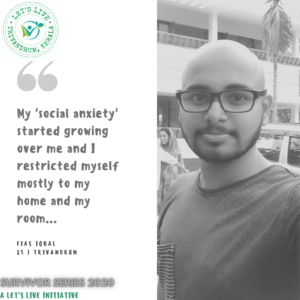
I have always been overly self-critical, and that has taken a toll on my self-esteem and confidence. To add to that I had failed trying to live up to the ideals set forth by the society. All of those put my mental health on a downward spiral. My ‘social anxiety’ started growing over me and I restricted myself mostly to my home and my room.
Something inside me wanted to fight against these crippling thoughts. Once in a while I would have a bout of energy and that warrior inside me would dominate over me. It was on one such occasion that I decided to act against my ruminating mind and socialize. That was, as they say, the turning point. As I reached out, ‘The Orange Room’ came to my sight. It was as if someone had kept it there so that I could find it. After some initial hiccups I finally set out on the journey to discover myself. Opening up to someone who would listen patiently without judging, released the pressure that had built up over time.
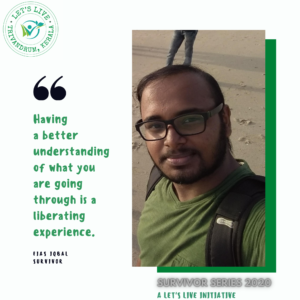
Having the right space to express oneself is equally important in the process of healing. I finally felt like I found one. Moving on, I got to interact with like-minded people about topics that really mattered. We would share our experiences. I realised that I am not alone in this. Having a better understanding of what you are going through is a liberating experience. A year later, here I am, still in the process of healing, one step at a time. I have made much progress and now have a better understanding of myself. Most importantly I learned not to lose hope.
— Fias Iqbal
Hi, I am Hasna Fathima. And here’s my story of survival.
 I am a single mother of three children but my story is not about how I survived a broken marriage. Mine is rather the story about how I started a journey into myself and how seemingly adverse life situations have led me into this.
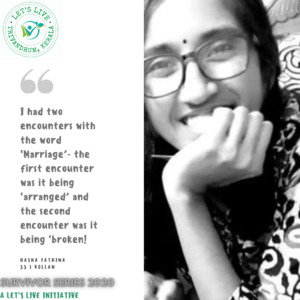
I had two encounters with the word ‘Marriage’, the first encounter was it being ‘arranged’ where I met a man once at my home and we talked for five minutes leading into an arrangement of an apparently lifelong partnership within a month. The second encounter was it being ‘broken’ where we both were struggling to be nice to each other but stayed together for the sake of it or to not to hurt each other, and finally one among us had grabbed the courage to move out and be free. So, it was actually ‘breaking free’ rather than being ‘broken’ and in fact I am grateful to my partner for having taken the first step outside.
Few days after he left me, I started noticing that I am not sad and suddenly there was lot of space surrounding me. But it took much more time to make myself come out of my own conditioning as well as beliefs about the definitions of a relationship. When the need to compromise and please each other on a daily basis was no more there, I could see things with more clarity than before.
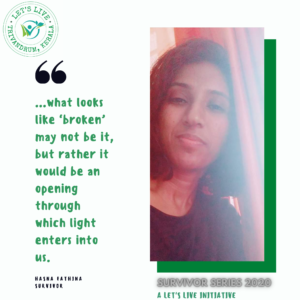 I started enjoying old hobbies which I had kept away after marriage. I learned some new skills that challenged myself and eventually help me build new brain connections and forgo the old traumatic memories. I travelled, just to move. I got my own car and started driving after almost 13 years. Whenever I felt the need for support, I dropped in at the Orange room, which was my perfect idea of a non-judgmental listening space. We organized support groups for single parents and shared our stories!
Survival is a different journey for each of us. But as a person, what helped me was trying to find the real meaning out of what looked like a ‘tragedy’ rather than following the narrations society puts onto a separation. Going back to my encounters with words, what looks like ‘broken’ may not be it, but rather it would be an opening through which light enters into us, as Rumi rightly said.
— Hasna Fathima
Hi, I am Dileep. I am a Suicide Attempt Survivor. And here’s my story of Survival.
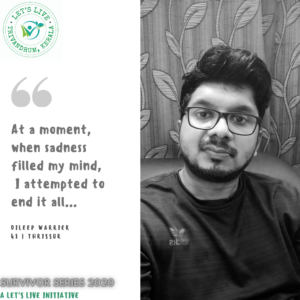 I was passing through a stormy marriage, where I was also part of the problem and it often created a lot of anxiety and unhappiness. At times when sadness filled my mind, I was contemplating again and again about my purpose in life or rather the lack of it and about broken relationships. In one such moment, I attempted to end it all. I survived an attempt on suicide and I am happy to be alive again!
I went through counseling and also I did a little bit of solo travelling. I understood my foibles. I realized that the anxiety about “not so perfect” life and “not so perfect” relationships existed only in my mind. After my divorce, it was a bit difficult to build new relationships, but the travelers, volunteers, survivors and common people like us, whom I met in my various trips, made me stronger, happier and less heavy at heart.
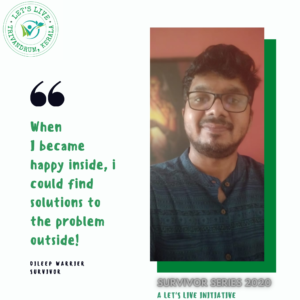 Nowadays I am happy and I have learnt how to love myself and my own idiosyncrasies. When I became happy inside, I could find solutions to the problem outside. I became more creative and I started connecting with people. So, I am not someone who would say that, we can easily get away from the thoughts of loneliness, anxiety and suicide. The lesson I learned from all this, is to focus only on living and not on comparing ourselves with others. Life is a bit of trial and error, so it’s okay to feel sad about failure, but we should keep trying!
At a moment, when sadness filled my mind, I was evaluating again and again about lack of purpose and broken relationships. In one such moment, I attempted to end it all. I survived an attempt on suicide and I am happy to be alive again! When I became happy inside, I could find solutions to the problem outside.
— Dileep Warrier
Hi, I am Jemimah. I am a law student, living in Kochi. And here’s my story of survival.
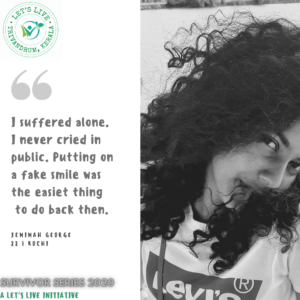 From a very young age I had the feeling of being unwanted, I felt I was a burden and I shouldn’t have been born. But I thought this feeling was very normal and would go away. But it always stayed. From my childhood to the age of 18 years was the time I suffered alone. As a child I was scolded by my mother for crying. I felt that I was the problem all the time. I never cried in public and wanted to present myself as a happy person. I didn’t want my friends to know about my issues, because i didn’t want them to waste their time trying to solve my issues. Putting on a fake smile was the easiest thing I could do, all because of the practice from a young age. I have tried to suffocate myself. But again I knew self-harm would affect my family’s reputation, my sister’s future, so I was caught up in the struggle between life and death.
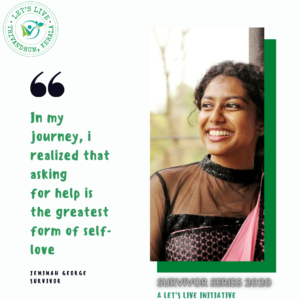 When I joined college, I got awareness about mental health from various sources. And this made me understand that my suicidal thoughts are not normal and it should be addressed. Slowly I started talking about it to my friends, then my sister and dad. But I still kept the heaviness of the feeling from them. The suicidal thought hit hard when a friendship turned into toxic relationship and broke apart. I tried to hide my pain from my friends and even myself by refusing to seek help. One day somehow I summoned up the courage to talk about it to a friend and she helped me to get more help. Slowly the wound was being opened and my friend Lettisha suggested me to read the book The Artist’s Way, which led me to journaling, self-care and affirmations. Opening my wound to my close friends made me realize that all these years I have betrayed myself. Being part of the self-help group, named Soul as a Race has given me the feeling that asking for help is the greatest form of self-love. The unwanted thought to kill myself has disappeared and it doesn’t seem to appear anymore, even when I am caught up in a tough situation.
I am grateful to all my friends who were always there for me – who listened to me without judging me and for showing care and compassion. I am so grateful to myself – for being there through all these years of pain and struggle.
— Jemimah George
Hi, I am Anoop. I studied B Tech , I have one more paper to clear. Currently I’m a piano teacher. And here’s my story of survival.
 Although I had mood swings throughout my life, depression struck me when everything was going fine.I was going to gym, making money, eating good food and living a normal life. Initially I had no idea what I was going through; I was on my phone all the time.
Gradually my sleep got reduced and simultaneously stress and sadness increased. I was crying all the time and no one knew. I was scared and kept all this private. The pain was too much that I felt it’s better to die than to live in this grief without any specific reason. I was sad about everything. This stage continued for two months and I felt I should do something about it.
I realized that I should see a doctor and seek help and understand what’s wrong with me. But I didn’t know where to go, whom to approach. My family also didn’t have much idea about this topic. Later when I discussed this with one of my piano students’ father – who is a neurologist – he advised me to go see a Psychiatrist. My parents and relatives were skeptic – they told me not to take meditation. But I didn’t listen to them – Only I knew what I was going through – and I needed relief. I took medicines for my Depression and slowly I could start functioning again. I became more stable and resumed my piano teaching. I also educated my family about depression and medication and all .Now they know and they support me in my fight against depression.
Now I am in the process of reducing my medication. And from my experience I want to say that – Be patient – it will take time – but you will be okay 🙂
A few things that helped me during my recovery are:
- Medication
- The Orange Room ( a non-judgemental listening space of Let’s Live)
- Yoga & Meditation, Daily Workout
- Taking time for myself, Travel
- Quitting social media, Avoiding negative friends
- Family & Friends/ Mentors usually experienced people in their 40s- I have a handful of them
- Awareness videos in YouTube about Mental health
“I think Depression has some Positive sides too. It made me more empathetic. I can understand that others might be going through hell, just like me. So nowadays I don’t judge people.”
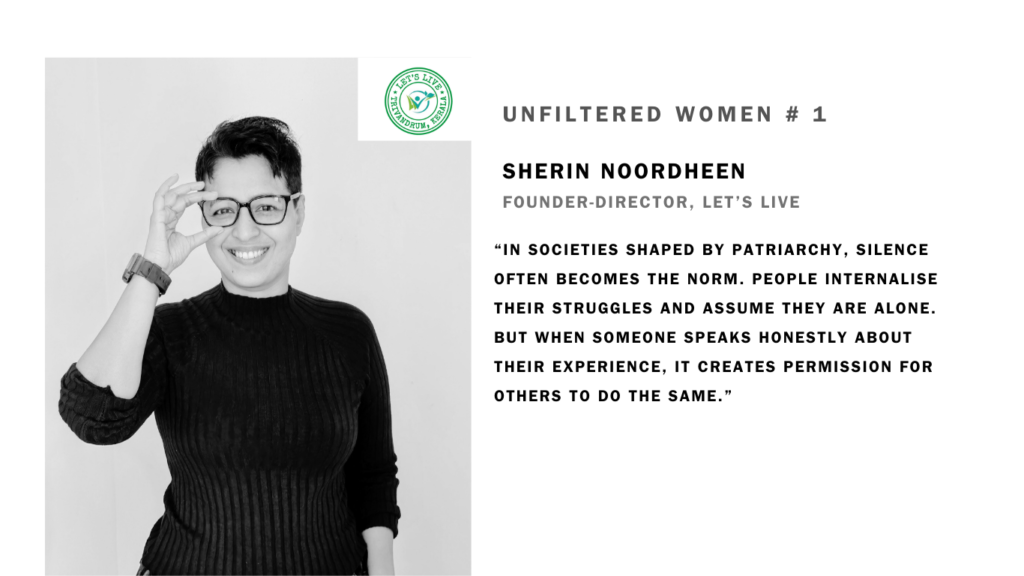
I started Let’s Live three years ago with a simple but urgent mission -to prevent youth suicides in Kerala and to create spaces where young people can speak openly about their struggles.
On September 10, 2020, World Suicide Prevention Day, I opened our Survivor Series 2020 with my own story.
I am a suicide survivor. I lost my father to suicide when I was six years old. Growing up, I experienced episodes of clinical depression and periods of suicidal ideation. Nearly a decade ago, I received a diagnosis of Borderline Personality Disorder – a name that attempted to define what I was going through. Over time, that diagnosis was revisited, questioned, and even reconsidered, especially as I began living a productive and high-functioning life. But what remained constant was this: the journey of understanding my mental health.
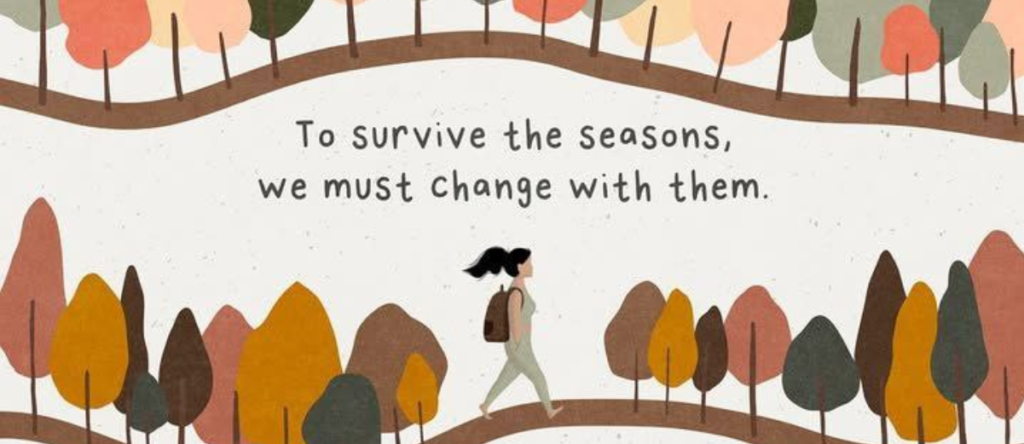
One of the most important lessons I’ve learned is this – you are not your condition. A diagnosis is not an identity. It is a description of a phase, a pattern, or a set of symptoms. It does not define who you are. You are a human being moving through different seasons of life, and sometimes one of those seasons may be depression. But you are always more than a label.
Healing begins with awareness. Take responsibility for your thoughts, emotions, and responses. Learn to acknowledge what you feel without shame. Learn how to help yourself. Learn when to ask for help. Learn whom to ask for help.
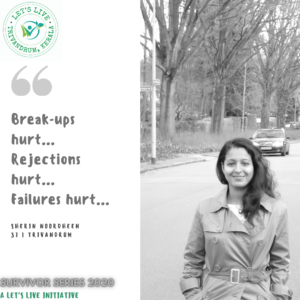
Break-ups hurt. Rejections hurt. Failures hurt. Pain can feel unbearable. Yet pain is also one of life’s greatest teachers. With time, patience, and reflection, it can bring clarity, resilience, and deeper self-understanding. Not immediately. Not easily. But eventually. Sometimes survival simply means holding on long enough for things to make sense.
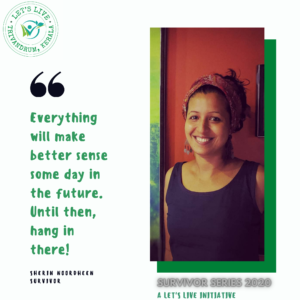
With self-love, compassion, and kindness toward yourself, it is possible to manage your mental health. It’s okay not to be okay -as long as you are willing to find your way back, one step at a time.
Through the Survivor Series 2020, we share 30 stories of survival from September 10,2020 to October 10 , 2020 – voices from across India speaking about struggle, recovery, and resilience. Our hope was simple: that every story would remind someone that they are not alone.
If even one person finds hope in these stories, then the purpose is fulfilled.
With hope and solidarity,
Sherin Noordheen
Founder-Director, Let’s Live